
Rimani aggiornato sui nostri bandi e sui nostri progetti
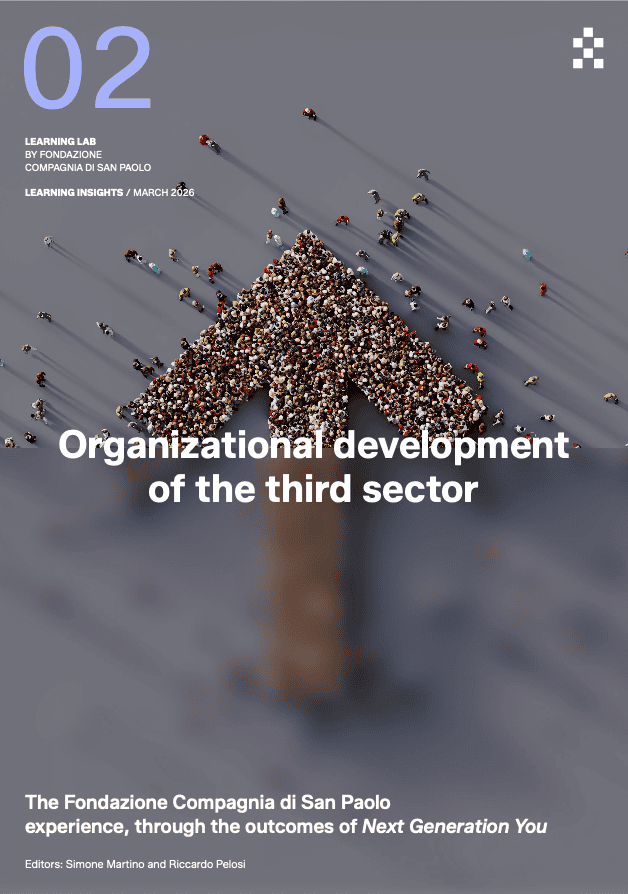
In recent years, capacity building has established itself as one of the most important strategic levers that philanthropic foundations use to structurally strengthen third-sector organizations, by enhancing their effectiveness, sustainability and capacity to generate impact in the medium to long term.
Against a backdrop of increasingly complex, unstable and interconnected social needs, strengthening organizational capabilities is no longer ancillary or merely instrumental to the implementation of individual projects; it is a central plank of philanthropic policies designed to deliver systemic change.
The international literature and the experiences of the leading foundations, however, show that capacity building is an intrinsically complex area, not only in terms of design, but also in terms of implementation and evaluation.
Processes of organizational change are rarely straightforward, and depend to a large extent on context and the interaction between financial resources, skills, governance structures, leadership and organizational culture. This complexity generates a structural tension between the need for organizations to equip themselves with recognizable, comparable tools and models, and the need to adapt interventions to the specific characteristics of the organizations involved, in order to avoid unduly standardized or prescriptive approaches.
To address this complexity, the Foundation has been promoting interventions tailored to the specific needs, strengths and fragilities of each organization, as from the four-year period 2021-2024, for the specific purpose of fostering their medium-to-long-term autonomy. The 2025-2028 Strategic Plan has further developed this framework, by formalizing four cross-cutting methodologies – Mobilization & Partnership, Learning, Advocacy and Internationalization – and establishing three key principles for contemporary philanthropy: trust, risk and flexibility. Within this framework, organizational enhancement becomes a vehicle for making planned flexibility operational, by facilitating the construction of sustainable local ecosystems and the generation of long-term transformational and multiplier effects.
This white paper forms part of the above framework, and has a clearly defined and delimited goal, namely to conduct an in-depth analysis of a specific capacity-building programme – Next Generation You (NGYou) – with a view to gaining useful insights to help shape the policies and practices of the foundations and other actors involved in boosting the organizational capacity of the third sector. The paper is intended neither to provide an exhaustive record of the capacity-building initiatives promoted by FCSP, nor to propose universally valid models, but to use a solid, documented case study as a means of insider analysis.
The decision to make Next Generation You the focus of this white paper was driven by multiple factors. Firstly, NGYou is one of the most structured and continuous capacity-building initiatives that FCSP has promoted. Its multi-year duration and its roll-out in multiple editions enables us to observe not only the immediate effects of the interventions, but also the trajectories of organizational change that it has given rise to over time. Secondly, the programme stands out for its approach, which combines dedicated financial resources and support in the form of consultancy, training courses and peer-to-peer learning spaces, in such a way that it deliberately targets organizational development and not just project support.
Part I
Theoretical overview and positioning of Fondazione Compagnia di San Paolo
1. The evolutionary process of capacity building / 21
Editors:
Paolo Biancone / University of Turin – “Valter Cantino” Department of Management
Simone Martino / Fondazione Compagnia di San Paolo – Evaluation Office, Learning Department
Lucia Schiavon / Ca’ Foscari University of Venice – Department of Economics
2. The FCSP approach: a blend of capacity buildingand organizational development / 65
Editors: Alessandro Di Antonio / Fondazione Compagnia di San Paolo – Data and Planning Office, Learning Department
Riccardo Pelosi / Fondazione Compagnia di San Paolo – Evaluation Office, Learning Department
3. Next Generation You: framework of the experimentation and its evolutions / 88
Editor: Daniela Gregnanin / Head of the Boosting Innovation Mission, Planet Goal – Fondazione Compagnia di San Paolo
Part II
The case of Next Generation You: analysis of implementation, support systems and evolution over time
4. How did Next Generation You work? The results of an implementation analysis / 107
Editors: Matteo Moscatelli / Catholic University of Milan – Department of Sociology
Sara Vallerani / Institut de Recherches Sociologiques, Université de Genève
5. Development and transparency of professional skills: vertical themes, training and learning by doing / 129
Editor: Emanuele Nervo / Encouraging Active Participation Mission, Culture Goal – Fondazione Compagnia di San Paolo
6. From reporting to impact: the evolution of social impact assessment and lessons learned from the Next Generation You call for proposals / 147
Editors: Paolo Biancone, Silvana Secinaro, Davide Calandra, Federico Lanzalonga, Federico Chmet, Ginevra Degregori / University of Turin – “Valter Cantino” Department of Management
7. Beyond evaluation: a changing third sector. Approach, evidence and perspectives from the experience of the Next Generation You call for proposals / 168
Editors: Carlotta Cerri, Giorgia Perra, Paolo Venturi / AICCON – Research Center
Part III
The impact of Next Generation You
8. How has the relationship between the Foundation and its beneficiary organizations evolved and what impact has the project had? Evidence from the qualitative evaluation / 185
Editors: Matteo Moscatelli, Teresa Betti / Catholic University of Milan – Department of Sociology
9. Organizational and management capacity of third-sector organizations. The impact of the Next Generation You programme / 211
Editors: Igor Benati, Greta Falavigna / CNR – IRCrES
10. Economic and financial sustainability of the organizations. The results of the Next Generation You impact assessment / 239
Editors: Silvio Cuneo, Riccardo Pelosi, Marco Ratti / Committee for the evaluation of the economic and financial sustainability of the winners of the Next Generation You call for proposals

Rimani aggiornato sui nostri bandi e sui nostri progetti
Compila il form e decidi su quale argomento vuoi ricevere notizie