


FCSP supports its philanthropic mission with income from the management of its financial assets, which amounted to €13.1 billion, measured at market values as at 31 December 2025.
FCSP’s assets are managed according to the principles of diversifying financial risks, while conserving and increasing the real value of the portfolio in the long term. FCSP’s assets derive from the process of privatisation of the Turin-based bank Istituto Bancario San Paolo di Torino, which began in the 1990s.
Strategic diversification of investments
Initially, FCSP’s assets were invested entirely in the transferee bank, but as a result of a policy of diversification, they are now invested in a wide range of financial asset categories on international markets, including global listed shares, government and corporate bonds, private equity, venture capital, hedge funds and infrastructure.
The assets consist of direct investments, which in addition to the stake in the transferee bank, include other institutional investments such as Banca d’Italia and Cassa Depositi e Prestiti, and investments in projects linked to the mission objectives (mission-related investments), as well as investments in funds managed by third-party asset managers or in asset management companies, which make up the diversified portfolio across international markets.
The funds managed by third-party asset managers are mainly held in two funds of funds, one for liquid assets and one for illiquid assets, managed by Fondaco SGR, an asset management company in which FCSP holds a 38% stake.
Portfolio risk is controlled mainly by diversifying investments by sector, geographical area and issuer, and by carefully assessing the cash requirements of FCSP’s institutional activities, which are met by the revenues generated from asset management.
Investment diversification is ensured by establishing a strategic asset allocation.
This allocation specifies the proportions of the various asset classes in the diversified portfolio, taking account of the composition and income capacity of the strategic investments.
The investment process is governed by FCSP’s governing documents, such as its Constitution, the Regulations Governing Asset Management Methods and Criteria and the corresponding Implementing Document, approved by FCSP’s General Council.
An Investment Committee, made up of members of the Management Board and external experts, is tasked with supporting the Management Board and submitting opinions to it.
Sustainable investing
The Foundation has developed a responsible investment approach aimed at guiding asset management in line with its values and with a long-term perspective.
The responsible investment approach defined by the Company focuses first and foremost on avoiding investments in assets that are not aligned with its mission, by establishing ethical exclusion criteria regarding sectors and companies that conflict with this mission.
Furthermore, when making investment decisions, managers are required to integrate environmental, social, and governance factors, with the goal of reducing financial risks and steering the portfolio toward more sustainable entities, including through stewardship activities aimed at promoting value over time.
Finally, a portion of the portfolio is allocated to impact investments—known as Mission-Related Investments—which, by combining financial returns with positive social and environmental impacts, contribute to the Foundation’s objectives (Culture, People, Planet) and the relevant Sustainable Development Goals (SDGs).
Portfolio composition
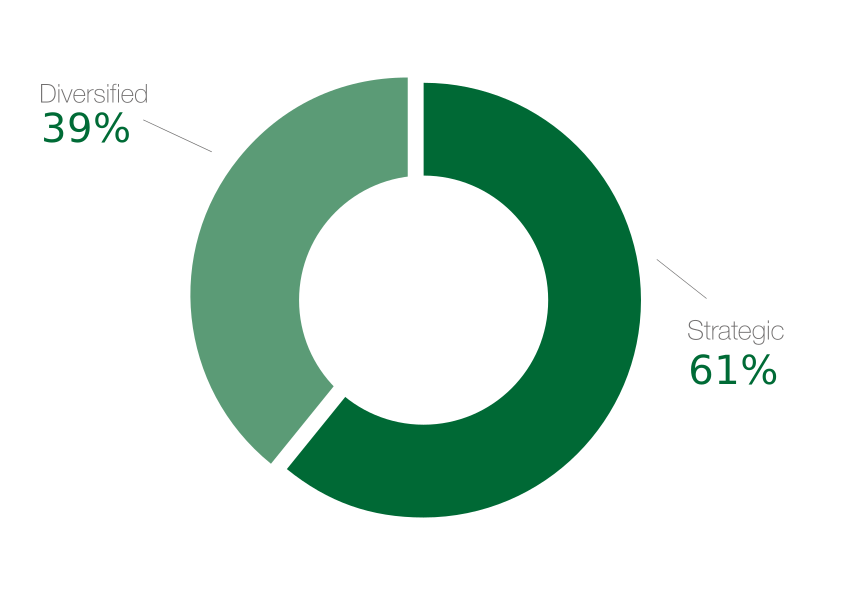
At the end of 2025, the total market value of Fondazione Compagnia di San Paolo’s financial asset portfolio was €13.1 billion. As for the composition of that portfolio, as at 31/12/2025 the strategic portfolio, comprising the equity investments in Intesa Sanpaolo, CDP, Banca d’Italia and other holdings, as well as mission-related investments (MRIs), accounted for 61% of the total financial assets. The “diversified” portion of the overall portfolio—represented by investments in funds of funds managed by Fondaco SGR S.p.A., investments in money market instruments, and cash—accounted for approximately 39% of the total.