

The action research conducted in primary schools across Piedmont and Valle d’Aosta analyses the effects of orchestral practice on musical skills, relationships between children, and motivation to study, highlighting the role of the methods used to implement the project.
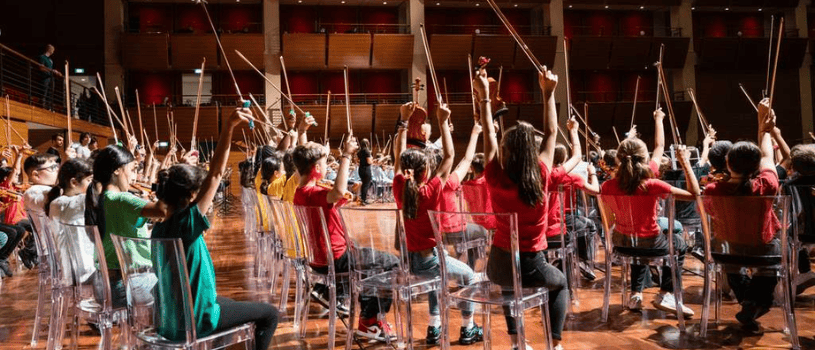
The Consonanze Project introduced orchestral practice in 15 school sites across Piedmont and Valle d’Aosta, involving 658 children in an action research programme carried out between 2021 and 2026.
The new Evaluation Report, published by the Evaluation Office of Fondazione Compagnia di San Paolo as part of the Learning Department, examines the outcomes of this five-year experience, exploring the effects of orchestral practice on musical skills, peer relationships and motivation to study.
Delivered by the Developing Skills Mission of the Culture Goal, in collaboration with Fondazione per la Scuola, the project promoted group music-making in primary schools, leading to the creation of 10 new school orchestras, with support from four local partner music organisations, including Associazione Dedalo in Novara, Istituto Musicale Comunale Leone Sinigaglia in Chivasso, SFOM – Fondazione Viglino in Aosta and Musicanto in Piossasco.
Over the five years of the project, the research tracked the development of the experience through five data collection rounds (from T0 to T4), comparing the results of groups involved in orchestral practice with those of a control group. This longitudinal approach made it possible to track changes across the different dimensions examined throughout the project and analyse differences compared with traditional music teaching.
The research framework and the Scientific and Evaluation Committee involved lecturers and researchers from the University of the Aosta Valley, Aarhus University and the University of Geneva. The University of the Aosta Valley carried out the statistical analyses, while Fondazione Santagata per l’Economia della Cultura ETS conducted the qualitative study involving the organisations, practitioners and teachers who took part in the project.
In terms of musical skills, by the end of the first year, children participating in the orchestral programme had achieved significantly better results in recognising rhythm (+23%) and melody (+20%) than the control group.
The relational dimension also emerges as one of the most consistent outcomes. Making music together is associated with greater enjoyment of sharing and a stronger sense of belonging, with a 12% difference at the T1 assessment, which remained stable in subsequent years.
The evaluation also identifies a change in motivation to study. Over the course of the project, autonomous motivation, linked to more conscious engagement in learning, gradually increases, with a difference reaching 14% at the final T4 assessment. At the same time, a reduction in inattention and a decrease in amotivation (i.e. a lack of motivation to study) are observed.
A further factor concerns how the programme is delivered. The most pronounced results are found in orchestras that demonstrate greater adherence to Consonanze’s pedagogical principles, based on prioritising relationships over performance, flexibility in the programme and the use of improvisation. These aspects are complemented by collaboration between class teachers and music practitioners, who combine their respective expertise in shaping the educational experience.
The evaluation thus highlights the role of orchestral practice in the school context, alongside the importance of the quality of the educational experience and collaboration between the people involved.
The evidence gathered contributes to a deeper understanding of the potential of group music-making for learning and the development of positive relationships at school, providing useful guidance for designing educational initiatives that promote collaboration between schools and local music organisations.
For further information, please consult the Consonanze Project Evaluation Report, available to download in the Evaluation Library section of the Fondazione Compagnia di San Paolo website.