


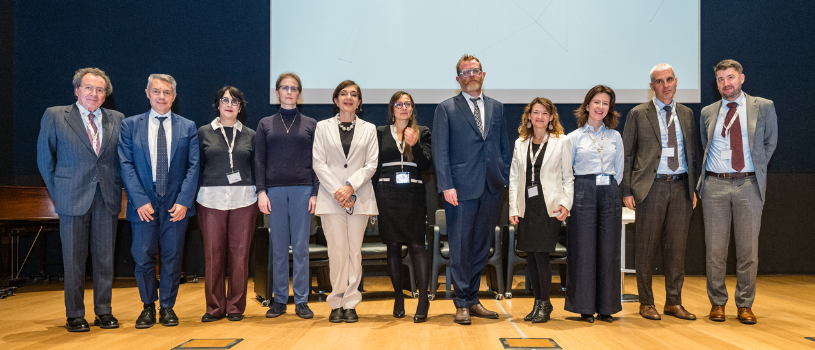
From the Geneva Summit to the presentation of the GESDA Science Breakthrough Radar® in Turin, Fondazione Compagnia di San Paolo is fostering international connections and promoting the use of tools to understand scientific developments and help shape future decisions.
On 4 November this year, the Beyond the Horizon: Anticipating the Future of Science and Technology event, held at the Auditorium Vivaldi in Turin, hosted the first official presentation in Italy of the GESDA Science Breakthrough Radar®, a tool that maps potential developments in scientific and technological research over 5-, 10 and 25-year time horizons, providing an evidence base for exploring the opportunities and challenges that may emerge over the coming decades.
Anticipating the future does not mean predicting it with certainty. Rather, it means developing the tools needed to understand ongoing changes, prepare for emerging scenarios and strengthen the ability of institutions, local areas and communities to adapt.
The event opened with an address by the Chair of Fondazione Compagnia di San Paolo, Marco Gilli, followed by remarks from the Chairman of Intesa Sanpaolo, Gian Maria Gros-Pietro and a keynote speech by Martin Müller, Director of Science Anticipation at GESDA.
Two round table discussions then explored key issues shaping the future of research and society. The first focused on the challenges arising from the convergence of artificial intelligence and quantum computing, with contributions by experts from CERN, IIT in Genoa and AWS.
The second examined the ethical and social implications of innovation and its impact on the world of work, with contributions from the Polytechnic University of Milan, ITC–ILO and IEO/Human Technopole.
The discussions brought together the opportunities offered by frontier science and the governance and social impact issues accompanying its development, highlighting the need to embed scientific anticipation in the processes of reflection and decision-making that shape the future, as concluded by the Secretary General of Fondazione Compagnia di San Paolo, Alberto Anfossi.
Scientific and technological transformations are having an increasingly profound impact on economic and social systems, creating new opportunities while raising questions that concern institutions, research and society. Understanding their possible trajectories and implications is essential to anticipating change and providing insights to inform public decision-making, thereby helping to prepare appropriate responses to future challenges.
Fondazione Compagnia di San Paolo recognises Science Anticipation as a strategic area for exploration and supports its development through its multi-year collaboration with GESDA – Geneva Science and Diplomacy Anticipator, a partnership that connects the local research community with international knowledge networks and promotes the exchange of tools and perspectives that help deepen understanding of scientific and technological developments.
Last October, Fondazione Compagnia di San Paolo enabled a delegation of universities and research centres to attend GESDA “The anticipation Summit” in Geneva. The delegation included theCandiolo Cancer Institute IRCCS, INOC – Istituto Nazionale Oncologico Candiolo, Fondazione Collegio Carlo Alberto, Italian Institute for Genomic Medicine (IIGM), the Polytechnic University of Turin, Istituto Italiano di Intelligenza Artificiale per l’Industria (AI4I), Bocconi University, the University of Eastern Piedmont and the University of Turin. The event provided an opportunity to encourage representatives of Italy’s research community to engage in international dialogue on the future directions of science.
This event provided the participating institutions with an opportunity to connect with an international community dedicated to exploring developments in frontier science and their implications for society.
The Summit also offered an important opportunity to discuss the role of philanthropy in supporting scientific research internationally and the conditions needed to ensure its sustainability and independence. In his address at the event, the Secretary General of Fondazione Compagnia di San Paolo, Alberto Anfossi, emphasised that philanthropic support should complement, rather than replace, public responsibility for funding science. Philanthropy can provide patient capital to support researchers, including during the riskiest stages of their work, and help create the conditions for independent, fundamental research to flourish for the benefit of society as a whole.
Bringing scientific knowledge into dialogue between research communities and public decision-makers broadens the evidence base on which to assess the opportunities and challenges of innovation and shape long-term strategies. It is through this dialogue between research, international relations and decision-making processes that the value of the collaboration between Fondazione Compagnia di San Paolo and GESDA becomes clear: making new perspectives available for analysis and fostering greater awareness of scientific and technological developments in discussions about the future.


