



The five finalists also included Kengo Kuma & Associates Europe, Guillermo Vázquez Consuegra Arquitecto SLP, Mario Cucinella Architects and ACPV Architects – Antonio Citterio and Patricia Viel. The winning design will be presented in early 2026.[/vc_column_text][/vc_column][/vc_row][vc_row][vc_column][vc_column_text]
Fondazione Torino Musei and Fondazione Compagnia di San Paolo, in collaboration with the City of Turin and with the support of Fondazione per l’architettura / Torino, have announced the winner of the International Design Competition for the major Redevelopment, Revitalisation and Enhancement Plan for the GAM – the Civic Gallery of Modern and Contemporary Art of Turin.
The announcement was made this morning in Turin, at the Collegio Carlo Alberto, in the presence of the Chair of Fondazione Compagnia di San Paolo and Chair of the Competition Panel, Marco Gilli, the Mayor of Turin, Stefano Lo Russo, and the Chair of Fondazione Torino Musei, Massimo Broccio.
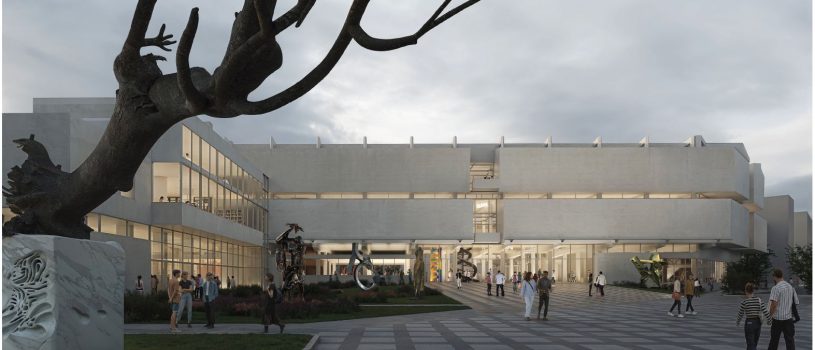
The design team of MVRDV, BALANCE Architettura, EP&S Group, Dr Michelangelo Di Gioia and Prof. Filippo Busato won first place. The Committee praised the winning proposal for its vision, design quality and functional coherence, recognising its ability to interpret the future role of the GAM.
Fondazione Compagnia di San Paolo will support Fondazione Torino Musei throughout all the implementation stages, contributing expertise and covering the full project cost of €27.5 million from the resources allocated to high-impact projects.
Statements
Turin’s Mayor Stefano Lo Russo commented: “The GAM was Italy’s first museum dedicated to modern art and has long played a strategic role in our city’s cultural life. Revitalising its national and international standing, while renewing and developing the avant-garde spirit that marked its founding, has been a priority of this administration from the outset. We are therefore extremely satisfied with the outcome of the international design competition, which sets the course for the GAM’s comprehensive redevelopment, revitalisation and enhancement, intended to position the museum as a leading centre for culture and innovation, opening a new chapter in its history”.
“For Fondazione Compagnia di San Paolo, this project is a concrete example of Advanced Philanthropy, an approach that brings together a range of tools and draws on the best practices of international philanthropy. Thanks to this approach, we were able to support Fondazione Torino Musei throughout the entire international design competition process, working effectively with the Real Estate Operations and Social Housing Area of PR.I.S.MA S.c.r.l. and with the Culture Back Office of the “La Venaria Reale” Conservation and Restoration Centre. The competition has fully achieved its objective of attracting leading international design teams and eliciting high-quality proposals capable of addressing the complexity of the GAM’s future. At the same time, it has provided an opportunity to restore the museum’s international profile and to strengthen its role within a renewed interpretation of urban space. The winning project envisions an open and revitalised GAM, one that balances the protection of the building’s historical values with a bold and necessary transformation. We regard this result as a strategic milestone: it will enable the GAM to further establish itself as a contemporary and innovative cultural infrastructure, actively engaging visitors and the wider city in its museum programme. For these reasons, Compagnia di San Paolo is committed to closely overseeing and continuously supporting the subsequent design phases and the full implementation of the work”, said Marco Gilli, Chair of Fondazione Compagnia di San Paolo.
“Today marks a historic day for the GAM, for Fondazione Torino Musei, and for our city. Thanks to the essential support of Compagnia di San Paolo, the most significant project of the Foundation’s Strategic Plan is now officially under way – said Massimo Broccio, Chair of Fondazione Torino Musei. The GAM, Italy’s oldest civic museum of modern and contemporary art, was admirably rebuilt in the postwar period through a project that was both unique and innovative for its time. Today, the museum is preparing to renew and relaunch that vision, projecting it decisively into the future. The GAM Redevelopment Plan represents the largest investment of its kind in Italy and ranks among the most ambitious museum renovation projects internationally in terms of scale and expected impact. Innovation and avant-garde thinking guide this extraordinary regeneration, reaffirming the spirit that shaped both the building’s original design and the museum’s founding mission. The project responds to the key contemporary challenges facing museums and cultural institutions today, including environmental sustainability, energy efficiency, architectural and technological innovation, and the development of new models of museum experience designed for future audiences. It places strong emphasis on the museum’s inclusive and social mission, as well as its role as a cultural leader within the city and on the national stage. Our warmest congratulations go to the winning team, among the most internationally distinguished, whose proposal compellingly interprets and fully embodies the spirit of this transformation. We also extend our sincere thanks to the two competition panels, whose exemplary expertise and dedication ensured a selection process of the highest professional standard.
Speaking during a live zoom call, the winning team stated ”When we began working on the project, we felt it was important to reassess certain past interventions. However, the site visit revealed that many elements should be preserved and, in some cases, restored, as this is a place with a long and valuable history that deserves to be carefully enhanced over time. The project extends beyond the building itself; above all, it is a project about openness. We see the GAM as a living institution, deeply connected to the city of Turin. Opening up the garden and the square means opening culture to the city, inviting people to move freely through all the spaces, from the public areas down to the basement and the storage facilities. We therefore envisioned a truly open building, one that balances respect for the existing interiors with the flexibility required for future exhibition formats. Finally, we would like to sincerely thank you for your trust and for entrusting us with the future of the GAM.”
A strategic project for the future of the GAM and Turin
The GAM regeneration project forms part of the broader framework defined by the Torino Musei Foundation’s Strategic Plan. Its objective is to return to the city of Turin and to the public a museum capable of integrating technological innovation, environmental sustainability and the enhancement of the building’s architectural and historical identity.
The redevelopment of the GAM represents an advanced model for the renewal of modern cultural heritage, designed to update the museum’s functions, broaden accessibility, improve the visitor experience and redefine the institution’s role as an open and inclusive cultural hub, fully integrated into the urban fabric and able to offer new spaces for community engagement and active participation.
This process is guided by a renewed focus on the GAM’s origins, its founding vision and the conception of a building that was, from the outset, marked by a distinctly avant-garde vocation.
Today, as in the past, the aim is to present a museum conceived as an experimental laboratory: a space open to new languages and capable of fostering new forms of relationship with the community.
The innovative spirit that shaped the GAM at its inception thus returns as a strategic reference point, guiding the museum’s transformation and ushering it into a new phase of its history. The proposed redevelopment therefore seeks to channel and further develop this experimental spirit, transforming it into a driving force for the GAM’s international repositioning and for the creation of an institution capable of addressing the cultural challenges of the next generation with design clarity and a long-term vision.
The international competition
The international design competition for the redevelopment of the GAM was structured in two distinct phases, conceived to ensure transparency, design excellence, and equal access for all participants. To guarantee uniform conditions, all exchanges between the commissioning bodies and the competing teams were conducted exclusively online through the concorsiarchibo.eu platform of the Order of Architects of Bologna.
The first phase
The first phase, which was conducted openly, focused on the evaluation of candidates’ curricula, qualifications, and professional experience, with the objective of selecting the teams to be admitted to the final phase. Participation was both broad and highly international. Forty-nine architecture and engineering teams from France, Germany, Japan, Italy, Lebanon, the Netherlands, Spain, Switzerland, the United Kingdom and the United States submitted applications, confirming the strong interest of the international design community in a project of the GAM’s strategic importance. The selection of the finalists was entrusted to a technical committee that conducted a rigorous assessment of the applications and the quality of the professional profiles submitted.
The first phase led to the identification of five design teams, selected on the basis of quality, experience, and alignment with the objectives of the competition brief. These teams were admitted to the second phase of the procedure, which focused on the development of the design proposals.
The competition panel consisted of Emanuela Carpani, Francesco Novelli and Cristina Becchio (biographical notes are provided in the appendix).
Second phase
The second phase, conducted entirely anonymously, represented the core of the competition. The five finalist teams were required to develop and submit their design proposals in accordance with the guidelines set out in the brief and with the objectives for the regeneration and development of the Gallery.
The proposals were evaluated on the basis of architectural quality; innovation and environmental sustainability; technical and economic feasibility; and consistency with the functional and identity-related requirements of the GAM, with particular attention paid to each proposal’s ability to interpret the museum’s contemporary vocation and its role within the city’s museum system.
The Competition Panel, comprising five experts with recognised experience in architecture, urban planning and museum design, ensured a rigorous and independent evaluation process, drawing on multidisciplinary expertise and a careful assessment of the museum’s future needs.
The panel for the second phase included Marco Gilli (Panel Chair), Chris Dercon, Marco Filippi, Francesca Torzo and Esmeralda Valente. Biographical notes for all members are provided in the annex.
Final Competition Ranking
Following the second phase, which focused on the development of the design proposals, the Competition Panel evaluated the submissions from the finalist teams and established the merit-based ranking that identified the winning project:
(ranking listed in order)
- MVRDV (Rotterdam), Balance Architettura, EP&S Group, Dr Michelangelo Di Gioia, Prof. Eng. Filippo Busato
- Kengo Kuma & Associates Europe, Ralph Appelbaum Associates, Arch. Sonia Beatrice Calzoni, Deerns Italia SpA, CEAS srl, VDLA Vladimir Djurovic Landscape Architecture, Arch. Vincenzo Incardona, Arch. Anass Faid, Arch. Tommaso Mazzega, Arch. Francesco Patetta
- Guillermo Vázquez Consuegra Arquitecto SLP, PROAP – Estudos e Projectos de Arquitectura Paisagista, GTRF – Tortelli Frassoni Architetti Associati, SEINGIM Global Service srl, 3ti Progetti Italia Ingegneria Integrata S.p.A., Diapason Ingegneria S.r.l., Geologo Dr Marco Giovannozzi, Eng. Alessandro Zichi
- Mario Cucinella Architects, Manens, Gae Engineering S.r.l., Milan Ingegneria SpA, WAU architetti, DOTDOTDOT, Alessandro Biglia
- ACPV Architects (architects Antonio Citterio and Patricia Viel), DBA SpA, LAND Italia srl, Metis Lighting, Artcloud Network International, FIONDA srl, Arch. Alberto Artioli, Beatrice Zanelli
Presentation of the winning design
The winning project will be presented to the public, following all standard regulatory checks, during a major dedicated event scheduled for early 2026. This event will provide the first opportunity to showcase the selected project vision and the strategic framework guiding the subsequent phases of development. Its primary aim is to engage stakeholders and share the process with the local community, the national and international cultural scene, and the broader artistic community, helping to strengthen the Museum’s profile while fostering a participatory vision for its transformation.[/vc_column_text][vc_masonry_media_grid element_width=”2″ css=”” grid_id=”vc_gid:1766479525814-e9589e70-cb71-4″ include=”40861,40859,40856,40863″][/vc_column][/vc_row][vc_row disable_element=”yes” el_class=”sdg-list-wrap”][vc_column][/vc_column][/vc_row][vc_row el_class=”sdg-list-wrap”][vc_column][/vc_column][/vc_row][vc_row][vc_column][/vc_column][/vc_row]