
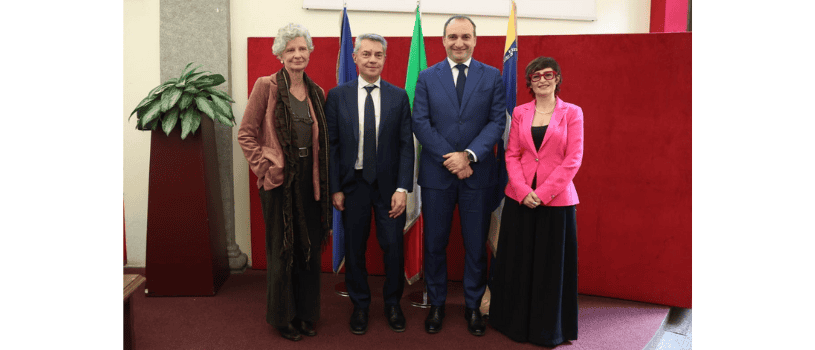
The City of Turin and Fondazione Compagnia di San Paolo have presented Città dell’Educazione (City of Education), outlining the initiative’s main activities and introducing the five new Eduteche (Educational Centres).
Turin, 14 January 2026 – Strengthening educational opportunities, preventing early school leaving, and supporting young people’s engagement in education and work; promoting education as a fundamental driver of the country’s social, economic and cultural development, starting from Turin: these are the goals of Città dell’Educazione, a multi-year initiative focused on the quality and innovation of services, the strength of local educational partnerships, and digital tools designed to guide and connect users, facilitate access to opportunities and measure impact.
With a total investment of €126 million in Turin over five years, Città dell’Educazione is an ambitious initiative promoted by Fondazione Compagnia di San Paolo – through its auxiliary body Fondazione per la Scuola – in partnership with the City of Turin and in close collaboration with the Ministry of Education and Merit. The initiative launches a major challenge for the territories it works with: placing education and the active participation of young people at the centre of long-term urban transformation policies. At a time marked by demographic decline and a shrinking younger population, Città dell’Educazione aims to provide high-quality educational and training opportunities, foster pedagogical innovation for inclusion and lifelong learning, engage the entire educational community, and collect, interpret, manage and use data effectively, strengthening the skills of school leaders, teachers, educators, practitioners and families, while adopting and supporting methods and pilot projects that are replicable and scalable.
“Young people are our future: the revitalisation and development of cities depend on them. And it is to them that we, as public institutions, must look, accompanying them on a path of growth and awareness of the challenges of tomorrow. Investing in education means not only providing children and young people with new tools for knowledge, but also for inclusion, community and citizenship. In this sense, the “Città per l’Educazione” initiative promoted by Fondazione Compagnia di San Paolo in collaboration with the municipal administration represents a model and a truly valuable investment for the new generations of this city. It is a project that will concretely enhance opportunities for learning and experimentation and will help to nurture the knowledge and talents of those who, in the coming years, will be fundamental in building the future of our community and our territory,” said the Mayor of the City of Turin, Stefano Lo Russo.
‘With Città dell’Educazione, we are today presenting a concrete commitment to Turin: we are putting resources, skills and innovative tools in place for a major systemic initiative, so that every child, boy, girl and young person can find the conditions here to grow, choose and fulfil their potential. “We believe that education and schools – together with families and other educational actors – are the decisive lever for long-term transformation, especially in a country marked by demographic decline and by social, economic and territorial inequalities. For this reason, schools, families, institutions and all those involved in educational communities are called upon to form a genuine educational alliance, in order to safeguard the rights of children and adolescents. The goal is to recognise and nurture the talents and potential of the new generations from early childhood onward, narrowing inequalities in access to opportunities and shaping aware, skilled citizens capable of facing the challenges of a constantly evolving world,” said Marco Gilli, Chair of Fondazione Compagnia di San Paolo.
“From the very beginning of our mandate, we have worked to expand educational opportunities for young children and to support families in the delicate task of balancing parenting and working life, while also addressing the specific pedagogical needs and developmental growth of girls and boys.” “The evolution of play centres into educational centres, spaces for socialisation that help build a strong bond with the educational community from the very first days of life, and the expansion of services within the Città dell’Educazione are a source of great pride for us. The initial data on how frequently these spaces are used confirms that we are moving in the right direction,” added Carlotta Salerno, Councillor for Educational Policies of the City of Turin.
“Città dell’Educazione is a systemic intervention designed to strengthen the capacity of schools and local communities to prevent educational failure through technical and scientific support. This includes training activities, assistance in the adoption of effective teaching methodologies, and ongoing supervision for teachers and school leaders. It is a concrete, fully implemented model of innovative educational governance, grounded in evidence, inter-institutional collaboration, and shared responsibility,” concluded Giulia Guglielmini, Chair of Fondazione per la Scuola.
A single vision, three complementary actions.
The initiative addresses a cross-cutting challenge: making education a continuous urban infrastructure, capable of accompanying people from birth to the age of 29 (and beyond, with a view to lifelong continuity).
Action 0–6: more opportunities for early childhood, greater quality, broader access, increased flexibility and closer proximity to families.
The 0–6 action aims to universalise educational and care opportunities while strengthening the overall quality of services.
The programme provides for more than 2,000 children aged 0–6 to gain access, for the first time, to new, high-quality, education-intensive services. It also aims for the City of Turin, supported in part by a dedicated app for all families with children aged 0–6, to reach the targets set by the European Union for 2030: a participation rate of 45% for children aged 0–3 and 96% for those aged 3–6.
The Eduteche.
Five new Eduteche have opened across the city: L’Aquilone (Corso Bramante 75), Il Paguro (Via Oropa 48), Il Drago Volante (Corso Cadore 20/8), Agorà (Via Fossano 8), and La Cinciallegra (Via Parenzo 42), all providing highly education intensive services.
These facilities represent a vital resource for local communities, offering children, families and the wider public access to people, services, and a wide range of educational, recreational, cultural and training opportunities. They are places for growth, care, and the promotion of well-being, designed to encourage participation and social interaction.
The Eduteche are the result of an intensive co-design process involving the City of Turin, Fondazione Compagnia di San Paolo, several charitable organisations, and the Turin Local Health Authority. Management is entrusted to charitable organisations, which in just seven months of activity have already engaged more than 350 children.
The 0–6 action will also be developed through:
- the expansion of services for children aged 0–3 and the enhancement of summer nursery activities;
- a stronger focus on inclusion, including transport subsidies and initiatives specifically designed for children with disabilities;
- the development of a 0-6 digital tool (a web app and mobile app) for families, to facilitate access to information, bookings, and the use of services from a child’s birth onwards;
- the training and professional development of educators and educational staff;
- the strengthening of alliances among public institutions, civil society organisations and families, with a view to building a city that is welcoming to young children and their families.
Action 6–19: data, training, and educational communities to tackle early school leaving and inequality.
The 6–19 action aims to enhance young people’s ability to shape their own futures by strengthening the connection between schools and their local communities.
Each year, more than 15,000 young people are expected to take part in extracurricular activities, with at least 60% of primary and secondary schools involved and over 1,500 school leaders and teachers participating in training programmes.
The following initiatives will be consolidated and further developed:
- collaboration among Fondazione per la Scuola, Fondazione Compagnia di San Paolo, the Ministry of Education and Merit, INVALSI and the Polytechnic of Milan to assess the risk of early school leaving at individual schools and to anticipate personalised teaching tools and practices through the integration of data from multiple sources (student registries, INVALSI data and electronic registers).
- an e-learning environment to deliver training for school leaders and teachers and to support communities of practice among school leaders, Città dell’Educazione representatives within schools, and teachers involved in the various training pathways;
- structured training and support programmes for school leaders and teachers, within a city-wide network that already includes 53 primary and secondary schools and has trained 821 teachers to date;
- initiatives to involve and actively engage families, recognising their central role within the educational community;
- actions to promote the active participation of young people, such as service learning and peer education, and to build a stable ecosystem for youth engagement among 16- to 19-year-olds;
- pilot initiatives and projects, including Provaci ancora Sam (“Try Again, Sam”) and those supported through the RiSalto Call for Proposals, aimed at preventing early school leaving, strengthening educational communities, reinforcing the role of families, and creating new learning opportunities beyond school hours.
16+ action: activation, employability and access to opportunities for young people “on the threshold”
For young people aged 16 to 29, the goal is to increase the number who enter employment, actively seek work, or participate continuously in vocational education and training.
In Turin, the initiative is expected to reach at least 10,000 young people, with 4,500 involved in guidance, empowerment and skills development activities, and 1,500 supported into employment, particularly those with low and medium-low employability profiles.
To date, more than 1,160 young people have already been engaged: 330 have completed or are currently undertaking an internship, and around 390 have secured employment. Alongside these actions, a process has been launched to identify and develop innovative solutions to support youth activation and respond to labour market challenges. The Unlock Call for Action has also been introduced to consolidate a city-wide infrastructure of organisational networks, co-building strategic alliances in the City of Turin to promote the activation, guidance and employment of young people. To date, the Call has involved over 30 organisations.
The intervention focuses on:
- collecting, analysing and managing city-level data on young people who are “on the threshold”, far from work and training experiences or with an uncertain vision of the future;
- designing and facilitating collaborative processes aimed at generating and introducing innovative solutions and tools to be tested within the intervention, including the involvement of the young people in the target group;
- integrated active labour market policy and socio-educational support services, developed thanks to skills gained in the field and based on solid and recognised experience;
- increasing employability and employment through processes of activation and involvement of young people developed within collaborative networks of institutional, economic and social actors;
- promoting cultural and intergenerational debate on the meaning and new visions of work.
The Città dell’Educazione initiative is also active in Genoa, Vercelli and Savona, offering a replicable model of intervention to encourage discussion on educational issues among the different territories involved in the initiative, to stimulate a cultural debate on education and work as drivers of the country’s well-being and growth, and to enhance the role of professionals involved in various educational responsibilities.